ALICE
"Asset Limited, Income Constrained, Employed" — households with income above the federal poverty guidelines but below the basic cost of living in their community


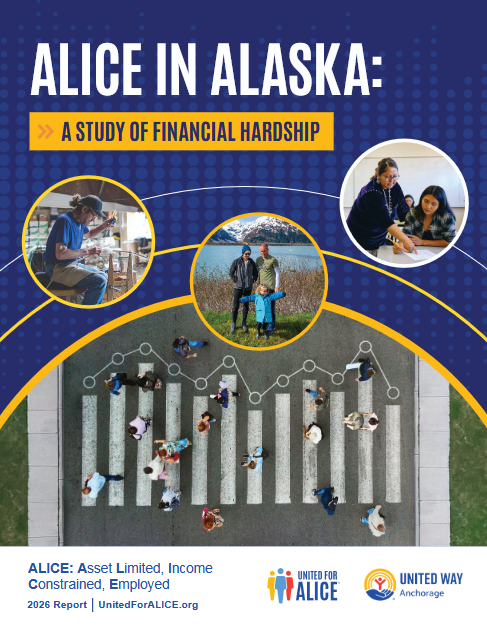
In partnership with United for ALICE, we've released a ground-breaking study of Alaska households that provides the most comprehensive picture of financial hardship in our state to date. This report looks beyond the traditional Federal Poverty Guidelines and focuses on an often-overlooked population that earns above that level but still can't make ends meet. Now, you can explore what it really costs for families in Alaska's communities to meet their needs.
ALICE® stands for Asset Limited, Income Constrained, Employed and refers to households that earn more than the outdated poverty levels but struggle to afford the essentials: housing, food, child care, transportation, healthcare, and technology plus taxes. United Way uses data and insights from our ALICE report to help inform how we support the financial security of working households in Alaska and directly address ALICE challenges that effect community members, families across Alaska, and even our state's economy.
When reading our ALICE report or hearing United Way discuss it, you'll notice some that we use some phrases repeatedly.

"Asset Limited, Income Constrained, Employed" — households with income above the federal poverty guidelines but below the basic cost of living in their community

Reflects the minimum costs of household necessities (housing, childcare, food, transportation, health care, and technology) plus taxes

Derived from the Household Survival Budget, the minimum average income that a household needs to afford basic living costs

Both ALICE and poverty-level households combined offering a more realistic picture of the extent of financial hardship
With income above the Federal Poverty Level, ALICE households often earn too much to qualify for public assistance but are still unable to cover basic household expenses. Are you ALICE? Use the ALICE Income Status Tool (below) to input your income, household type, and location to see your household ALICE status.
ALICE households are part of every community in Alaska and the nation. They span all races, ages, ethnicities, and abilities, though households of color are disproportionately ALICE. We rely on ALICE workers everyday. They’re our child care workers, home health aides, retail sales people, delivery drivers, cashiers, and more. They keep our communities running smoothly and have struggled for far too long.
It’s time to join together to acknowledge the financial hardship problem, create solutions, and take steps that ensure every Alaskan has opportunities to thrive.
Are you an advocate, community planner, policy maker, researcher, student, employer or just a curious Alaskan? You’ll find extensive interactive data and resources that accompany our 2026 ALICE in Alaska Report. The links below are just a sampling. You’ll find more at www.UnitedforALICE.org/Introducing-ALICE/Alaska.



By partnering with you, United Way is leading the effort to tackle the challenges impacting struggling households, create solutions that address their needs, and take steps to ensure every Alaskan can thrive.



[---]
United Way of Anchorage partners with United For ALICE, which is a U.S. research organization driving solutions to financial hardship that is led by United Way of Northern New Jersey.